Bioresonance has a history that stretches back several decades and is closely associated with the development of MORA therapy in Germany. What began as an experimental idea involving electrical signals, frequencies and the human body developed into a range of devices that are now used in complementary and wellness practices in different parts of the world.
Understanding the history of bioresonance helps explain where the modern approach came from, who developed it, and how the technology has changed over the years.
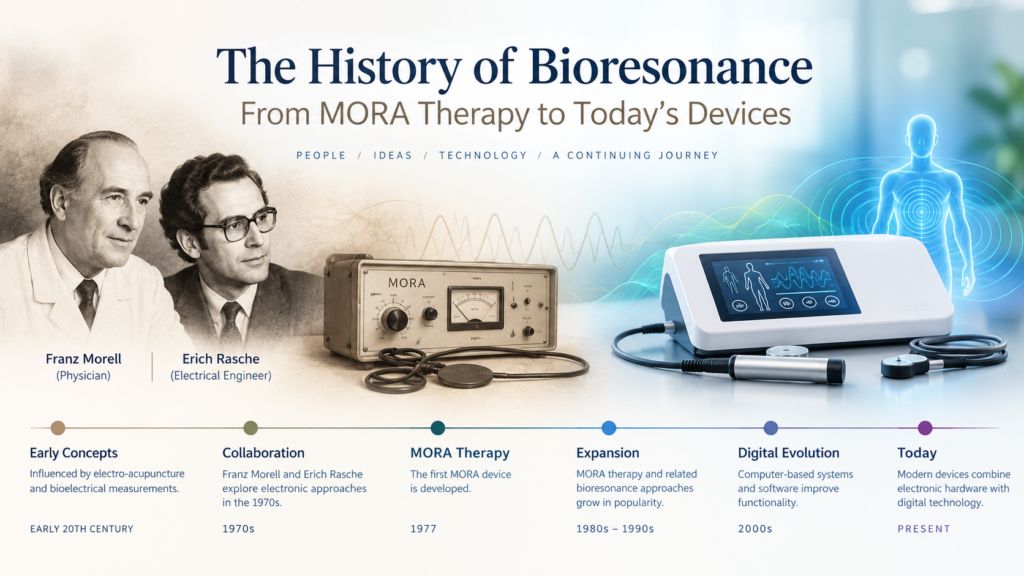
The story is particularly connected with two names: Dr. Franz Morell, a German physician, and Erich Rasche, an electrical engineer and Morell’s son-in-law. Their collaboration in the 1970s led to the development of the original MORA system.
Important: Bioresonance is generally considered a complementary approach. Its proposed mechanisms and clinical effectiveness remain subjects of scientific debate, and it should not be used as a replacement for appropriate medical diagnosis or treatment.
What Is Bioresonance?
Bioresonance is a complementary therapy concept based on the idea that biological systems produce measurable electrical or electromagnetic signals.
Practitioners of bioresonance propose that these signals can be detected, processed and, depending on the particular device and method, used as part of a complementary session.
The technology is not a single standardized medical device. The term bioresonance is now used for a variety of systems and approaches, which can differ significantly in their hardware, software and intended applications.
The historical development of the field is therefore important because many modern systems trace their origins, directly or indirectly, to the early MORA approach.
The Early Background of Bioresonance
The history of bioresonance did not begin with a single modern machine. Its development was influenced by earlier work involving electro-acupuncture, bioelectrical measurements and complementary medicine.
One important figure in this background was Reinhold Voll, whose work in electro-acupuncture influenced several practitioners working with electrical measurements and biological signals.
Franz Morell was also involved in this broader field of complementary medicine. His interest eventually moved toward the possibility of using electrical signals associated with the body and substances in a different way.
According to historical accounts from the MORA tradition, Morell and Erich Rasche began collaborating during the 1970s. Rasche’s engineering expertise was important because the proposed concepts required specialized electronic equipment.
This combination of medical experience and electrical engineering became an important part of the development of classical MORA bioresonance.
Franz Morell and Erich Rasche
Who Was Franz Morell?
Dr. Franz Morell was a German physician interested in complementary and biological approaches to health.
During the 1970s, Morell explored the idea that information associated with biological signals could potentially be processed electronically. His work eventually led to the concept that became known as MORA therapy.
Who Was Erich Rasche?
Erich Rasche was an electrical engineer and Morell’s son-in-law. His technical knowledge allowed the concepts being explored by Morell to be translated into electronic equipment.
Historical accounts describe Rasche as the engineer responsible for developing the technical systems needed to work with the signals and frequencies that Morell was investigating.
The collaboration between Morell and Rasche is therefore central to the history of bioresonance.
The Development of MORA Therapy
The name MORA comes from the names of its two principal developers:
MOrell + RAsche = MORA
The first MORA device is generally dated to 1977. Historical sources associated with the MORA system describe this as the beginning of classical bioresonance therapy.
The concept involved receiving signals associated with the body, processing those signals electronically and feeding them back through the device.
Historical descriptions of the technology refer to this as a way of working with the body’s own oscillations or frequency information.
The development of the first MORA device represented an important technological step because it moved the idea from theoretical discussion toward a dedicated electronic system.
A Simple Timeline of Bioresonance History
| Period | Development |
|---|---|
| Early 20th century | Earlier concepts involving radionics and electrical measurements influenced later alternative approaches |
| 1950s–1960s | Electro-acupuncture and biological electrical measurement approaches developed further |
| 1970s | Franz Morell and Erich Rasche explored electronic approaches involving biological signals |
| 1977 | The first MORA device was developed |
| Late 1970s | MORA therapy and related bioresonance approaches continued to develop |
| 1980s | Bioresonance technology became more established within complementary medicine circles |
| 1990s | Different companies and systems introduced new versions and related approaches |
| 2000s | Computer-based systems and digital technology increasingly influenced device design |
| Today | Modern devices combine electronic hardware with digital processing and software |
Historical sources identify 1977 as a key year in the development of classical MORA bioresonance.
From Early MORA Devices to Modern Bioresonance Technology
The technology available in the 1970s was very different from what is available today.
Early electronic systems relied heavily on analogue components and relatively simple electronic processing. Modern devices can use digital electronics, computer interfaces, software controls and more sophisticated signal-processing technology.
The basic concept promoted by classical MORA therapy has also been adapted and developed by different manufacturers and practitioners.
As a result, today’s bioresonance devices may look very different from the original MORA equipment.
Some systems use handheld sensors or electrodes, while others incorporate computer software and specialized measurement interfaces. The exact method depends on the manufacturer and the particular approach being used.
It is important not to assume that every device marketed as a “bioresonance” system operates according to the original MORA design.
How Has Bioresonance Technology Changed?
The evolution can be summarized in three major stages:
1. Analogue beginnings
The earliest MORA systems were based primarily on analogue electronics and the technology available during the 1970s.
2. Electronic development
During the following decades, manufacturers developed more sophisticated equipment and expanded the ways practitioners could interact with the systems.
3. Digital and software-based systems
Modern devices increasingly use digital processing, computer interfaces and specialized software. This has made equipment more flexible and easier to operate compared with many early systems.
This technological evolution is similar to what happened across many areas of electronics: larger analogue systems gradually gave way to smaller, computer-assisted and digitally controlled equipment.
MORA Therapy and Modern Bioresonance: What’s the Difference?
Although MORA therapy is historically important, MORA therapy and modern bioresonance should not automatically be treated as identical.
MORA therapy refers specifically to the approach associated with Morell and Rasche. The broader term “bioresonance” is now used for many different systems.
| MORA Therapy | Modern Bioresonance Devices |
|---|---|
| Originated in Germany | Developed by multiple manufacturers internationally |
| Associated with Morell and Rasche | Different developers and companies |
| First system developed around 1977 | Many systems developed later |
| Classical MORA concept | May use different technical approaches |
| Historically important to the field | Often incorporates modern digital technology |
This distinction is useful when researching the history of bioresonance because the term has expanded considerably since the 1970s.
What Does Science Say About Bioresonance?
The history of a therapy and the evidence for its effectiveness are two different questions.
Bioresonance has been used in complementary and alternative health settings for many years, but the scientific evidence supporting broad claims about diagnosing or treating diseases remains limited and contested.
Research into wider categories of “biofield” and energy-based therapies has produced mixed findings, and systematic reviews have called for better-quality research.
For this reason, responsible information about bioresonance should distinguish between historical descriptions, proposed mechanisms and scientifically established medical evidence.
Bioresonance should not replace conventional medical diagnosis, prescribed treatment or professional medical advice.
Why Is the History of Bioresonance Still Relevant?
The history of bioresonance is useful because it explains why MORA therapy remains an important reference point in the field.
The collaboration between Franz Morell and Erich Rasche brought together two very different areas of expertise: medicine and electronics.
Their work in the 1970s helped establish the technological foundation for what became known as classical bioresonance. Later developments introduced new hardware, software and approaches, creating the wide range of systems available today.
Modern practitioners and researchers can therefore look at today’s technology as part of a much longer story of experimentation, engineering and complementary healthcare.
Frequently Asked Questions
When did bioresonance therapy begin?
The modern history of classical bioresonance is generally associated with Germany in the 1970s. The development of the first MORA device by Franz Morell and Erich Rasche is commonly dated to 1977.
Who invented MORA therapy?
MORA therapy is associated with German physician Franz Morell and electrical engineer Erich Rasche. The name MORA comes from parts of their surnames: Morell and Rasche.
What does MORA stand for?
MORA is derived from MOrell and RAsche, the two individuals associated with the development of the original MORA system.
Is MORA therapy the same as bioresonance?
MORA therapy is a specific historical form of classical bioresonance. Today, however, “bioresonance” is a broader term used for many different devices and approaches.
Are modern bioresonance machines the same as the original MORA device?
No. Modern systems can differ considerably from the original MORA equipment. Advances in electronics, computing and software have changed how many contemporary systems are designed and operated.
Can bioresonance replace conventional medical treatment?
No. Bioresonance should not be considered a replacement for medical diagnosis or treatment provided by a qualified healthcare professional.
Conclusion
The history of bioresonance is closely linked to the development of MORA therapy in Germany during the 1970s. Franz Morell’s medical interests and Erich Rasche’s engineering expertise came together to create the first MORA system around 1977.
From those early electronic devices, the field continued to evolve. Advances in electronics and computing eventually produced more sophisticated digital systems, while the word “bioresonance” became associated with a much wider range of technologies and complementary approaches.
Understanding this history provides useful context for anyone interested in modern bioresonance. It also highlights the importance of separating the historical development of a technology from claims about its clinical effectiveness.
Today, MORA therapy remains an important part of the historical story of bioresonance, while modern devices represent the continuing technological evolution of a field that began more than four decades ago.