
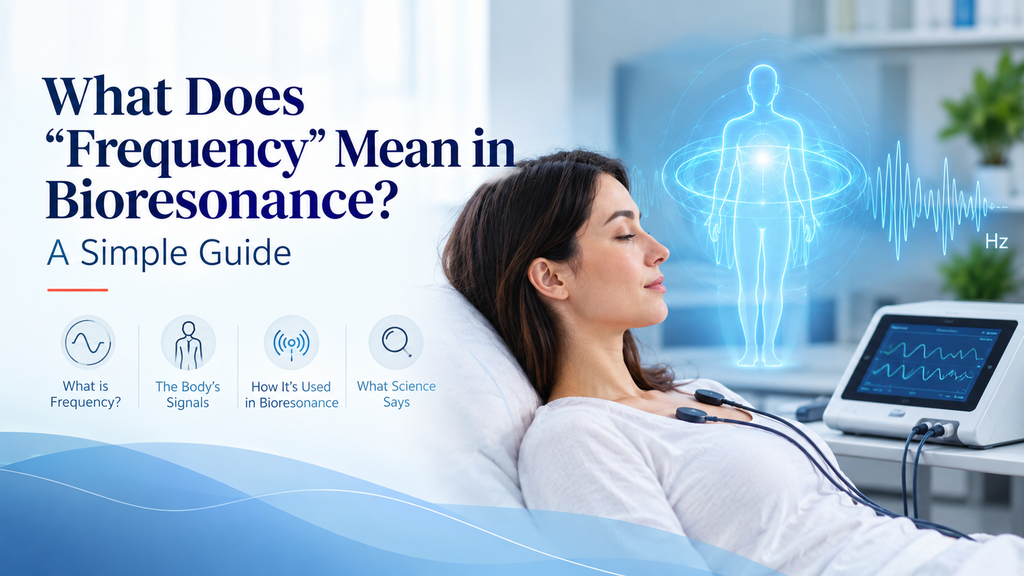
The word frequency often appears in discussions about bioresonance. Practitioners may use it when explaining how bioresonance devices are believed to interact with the body. But what does frequency actually mean, and how does it relate to bioresonance?
If you have ever wondered whether the human body has frequencies, what bioresonance equipment measures, or whether these frequencies can reveal information about your health, you are not alone. The terminology can sound complicated, especially when scientific language is mixed with complementary wellness claims.
The good news is that the basic concept of frequency is relatively simple. Once you understand how frequency works in physics, it becomes easier to distinguish established scientific principles from claims that still require stronger evidence.
In this guide, we explain what frequency means in bioresonance, how frequency is used in science and medicine, what bioresonance practitioners mean when they discuss the body’s frequencies, and what the available evidence tells us.
What Does Frequency Mean?
In simple terms, frequency describes how many times something happens within a particular period.
In physics, frequency usually refers to the number of complete cycles of a repeating event that occur every second. It is measured in hertz (Hz).
One hertz means one complete cycle per second. If something completes 100 cycles every second, its frequency is 100 Hz.
You can understand this concept through everyday examples. A musical note has a frequency that influences its pitch. Alternating electrical current changes direction at a particular frequency. Radio waves also have frequencies that help determine how signals are transmitted and received.
Frequency is not an unusual or mysterious concept. It is a measurable property used in many areas of science, technology, engineering, and medicine.
Understanding Frequency Through Everyday Examples
Imagine a swing moving backwards and forwards. If it completes one full back-and-forth movement every two seconds, its frequency is half a cycle per second, or 0.5 Hz.
Now imagine a speaker producing a musical tone. A higher-frequency sound generally has a higher pitch, while a lower-frequency sound has a lower pitch.
These examples illustrate how frequency describes repeating patterns. However, different types of waves and oscillations behave differently, so frequency alone does not tell us everything about a system.
What Does Frequency Mean in Bioresonance?
In bioresonance, the term frequency is commonly used to describe proposed electromagnetic signals or oscillatory patterns associated with the human body.
Bioresonance devices are marketed or used by some complementary therapy practitioners who believe that measuring or influencing certain signals may provide information about wellbeing or help guide a session.
The exact explanation varies depending on the practitioner, equipment, and method being used. Some descriptions suggest that the device detects particular signals from the body, while others propose that it can identify or influence patterns associated with health concerns.
It is important to distinguish these explanations from established scientific findings.
The human body does produce measurable electrical activity and responds to different forms of electromagnetic energy. However, this does not automatically mean that a bioresonance device can identify specific diseases, detect food intolerances, or improve health by changing supposed abnormal frequencies.
The key point: Frequency is a genuine scientific measurement. The claim that a particular bioresonance device can use frequencies to diagnose or treat a medical condition requires separate scientific evidence.
Does the Human Body Have Its Own Frequencies?
Yes, the body produces and responds to different measurable signals and rhythms. However, there is no single frequency that represents the entire human body.
Different organs, tissues, and biological processes have different electrical, mechanical, and rhythmic characteristics.
For example, the heart produces electrical activity that can be recorded using an electrocardiogram (ECG). The brain also produces electrical activity that can be measured using an electroencephalogram (EEG).
Other examples include breathing rhythms, muscle electrical activity, and biological processes that follow daily or seasonal cycles.
These measurements have specific meanings and uses. Scientists interpret them using established methods rather than assuming that every biological process can be explained by one universal frequency.
Examples of Frequencies and Rhythms in the Human Body
| Example | What it measures or describes | Established use |
|---|---|---|
| Heart electrical activity | Electrical signals associated with the heartbeat | ECG helps assess heart rhythm and other cardiac findings |
| Brain electrical activity | Electrical patterns produced by brain activity | EEG helps investigate certain neurological conditions |
| Muscle electrical activity | Electrical activity associated with muscle activation | Electromyography can help assess nerve and muscle function |
| Breathing rate | Number of breaths taken per minute | Helps assess respiratory status |
| Circadian rhythm | Approximately 24-hour biological timing cycle | Helps explain sleep-wake patterns and other daily processes |
These examples demonstrate that biological signals and rhythms are real. They do not, however, validate every claim made about bioresonance testing.
How Is Frequency Used in Bioresonance Equipment?
The way frequency is described in bioresonance depends on the particular device and the claims made by its manufacturer or practitioner.
Some devices are presented as measuring electrical signals or other parameters, while others are described as analysing or delivering signals at selected frequencies.
To understand what a device actually does, it is useful to ask three questions.
1. What Does the Device Actually Measure?
A scientific measurement should have a clearly defined quantity, a measurement method, and an explanation of how the result is interpreted.
For example, an ECG records electrical activity from the heart through electrodes placed on the skin. Its output is interpreted using established clinical knowledge.
If a bioresonance device claims to measure specific frequencies associated with an allergy, organ, or nutritional deficiency, it is reasonable to ask exactly what signal is being measured and how that measurement has been validated.
2. How Are the Results Interpreted?
Collecting a signal and interpreting its medical meaning are two different tasks.
A device may produce numerical readings, graphs, or frequency patterns. However, those outputs do not automatically demonstrate that a particular disease or imbalance is present.
For a test to be considered reliable, researchers need evidence showing that its results are sufficiently accurate and reproducible for the intended purpose.
3. Has the Claimed Application Been Scientifically Tested?
A device’s ability to detect or generate a signal does not prove that it can diagnose or treat a health condition.
Clinical research is needed to establish whether a particular application works as claimed. Results should ideally be reproducible in well-designed studies and independently evaluated.
This distinction is especially important when bioresonance equipment is advertised for allergies, digestive problems, chronic symptoms, or other medical concerns.
What Is the Difference Between Frequency and Resonance?
Frequency and resonance are related concepts, but they do not mean the same thing.
Frequency describes how often a repeating cycle occurs. Resonance is a phenomenon in which a system responds particularly strongly when it is driven at or near one of its natural frequencies, under suitable conditions.
A familiar example is a swing. When someone pushes it at appropriate points in its movement, the swing can move higher with repeated pushes. This illustrates how a system can respond strongly to a suitably timed input.
In physics and engineering, resonance is used to understand sound, vibrating structures, electrical circuits, and many other systems.
In bioresonance, practitioners sometimes use the concept to explain how devices supposedly interact with biological signals. However, demonstrating that resonance exists in physical systems does not establish that a particular bioresonance treatment can diagnose illness or improve health.
The proposed mechanism and the claimed health outcome must each be supported by appropriate evidence.
Bioresonance Frequency vs Medical Frequency Measurements
It can be helpful to compare bioresonance claims with established technologies that measure or use electrical and electromagnetic phenomena.
| Feature | Established medical measurements | Bioresonance claims |
|---|---|---|
| Scientific principle | Defined measurement methods based on established physics and physiology | Often explained using proposed interactions between the body and specific signals |
| Purpose | Specific clinical applications supported by validation | Varies by device and practitioner |
| Interpretation | Uses established criteria where validated for the intended application | May rely on interpretations that have not been adequately validated |
| Evidence | Supported by clinical research for recognised uses | Evidence for many advertised diagnostic and therapeutic applications remains insufficient |
| Role in healthcare | Can support diagnosis or monitoring for specific purposes | Should not be assumed to diagnose or treat medical conditions reliably |
This comparison does not mean every technology that uses frequency is equivalent. Each device must be assessed according to what it measures, how it works, and what evidence supports its intended use.
Can Bioresonance Frequencies Detect Health Problems?
Some bioresonance practitioners claim that frequency analysis can identify health problems before conventional symptoms develop. Others advertise testing for allergies, food intolerances, nutritional deficiencies, or problems involving particular organs.
These claims should be approached cautiously.
A reliable diagnostic test must demonstrate that it can distinguish between people who have a condition and those who do not. Researchers often assess this through measures such as sensitivity, specificity, and performance in the population for which the test is intended.
Bioresonance has not been established as a reliable diagnostic method for many of the conditions for which it is marketed.
For this reason, a bioresonance reading should not be used on its own to diagnose or rule out a disease, identify an allergy, or decide whether medical treatment is necessary.
If you have symptoms or concerns about your health, consult an appropriately qualified healthcare professional and use validated diagnostic methods where indicated.
Can Changing Frequencies Improve Health?
Another question people commonly ask is whether changing or balancing the body’s frequencies can improve wellbeing.
Some bioresonance practitioners propose that influencing particular signals may help the body return to a healthier state. However, this proposed explanation should not be confused with a demonstrated treatment effect.
There are established medical applications involving electrical or electromagnetic energy. For example, certain electrical stimulation therapies have specific uses, and defibrillators deliver electrical shocks in appropriate emergencies to help restore an effective heart rhythm.
These technologies have defined mechanisms, indications, and safety requirements. Their effectiveness does not prove that bioresonance treatments work through the same mechanisms or provide similar benefits.
To establish that a bioresonance intervention improves a health condition, researchers need appropriate clinical studies demonstrating meaningful benefits and evaluating potential harms.
At present, evidence supporting many claimed therapeutic uses of bioresonance remains inadequate.
Common Misconceptions About Frequency in Bioresonance
Several misunderstandings can arise when scientific terminology is used in complementary wellness settings.
Misconception 1: Every Health Problem Has a Unique Frequency
Biological systems are complex. Although measurable signals can provide useful information in specific contexts, it is not scientifically established that every disease has a unique frequency that a bioresonance device can reliably identify.
Misconception 2: All Frequencies Are Good or Bad
Frequency is a measurement, not a universal indicator of health. Whether a signal is useful, harmful, or clinically meaningful depends on its characteristics, the system involved, and the circumstances.
Misconception 3: A Frequency Reading Proves a Diagnosis
A graph or numerical reading does not automatically establish a medical condition. A diagnostic claim requires evidence that the measurement accurately identifies the condition in question.
Misconception 4: Natural Body Signals Prove Bioresonance Works
The body produces measurable signals, but their existence alone does not validate a particular device’s proposed mechanism or demonstrate a health benefit.
Understanding these distinctions makes it easier to assess bioresonance information without dismissing established science or accepting unsupported claims.
How to Evaluate Bioresonance Frequency Claims
If you are considering a bioresonance session, asking a few straightforward questions can help you make a more informed decision.
- What signal or physical quantity does the device measure?
- What does the displayed frequency represent?
- Has the device been independently validated for the specific purpose being claimed?
- Are the results supported by well-designed clinical research?
- Can the test reliably distinguish between people with and without the condition?
- What are the limitations, risks, and costs?
- Will the practitioner recommend appropriate medical assessment when necessary?
A responsible practitioner should be willing to explain the limitations of the method and should not promise guaranteed results or claim that frequency readings can replace conventional medical investigations.
If you choose to explore bioresonance as a complementary wellness service, maintain realistic expectations and do not stop prescribed treatment or delay medical care because of a frequency reading.
Final Thoughts: Understanding Frequency in Bioresonance
Frequency is an important concept in physics, engineering, and medicine. It helps describe repeating signals and plays a role in many established medical measurements.
In bioresonance, the term is often used to explain how practitioners believe their equipment interacts with the body’s signals. However, the scientific reality of frequency does not automatically validate every claim made about bioresonance testing or treatment.
The most useful approach is to understand what a device actually measures, distinguish proposed mechanisms from established findings, and look for reliable evidence supporting its intended use.
If you are curious about bioresonance, asking questions and seeking clear explanations can help you make informed decisions. For medical concerns, validated diagnostic methods and appropriate professional care should remain the priority.
Frequently Asked Questions About Frequency in Bioresonance
1. What does frequency mean in bioresonance?
Frequency in bioresonance generally refers to proposed electromagnetic signals or oscillatory patterns associated with the body. Practitioners may use the term to explain how their equipment is intended to measure or influence these signals. The validity of specific diagnostic or therapeutic claims must be assessed separately.
2. What is frequency measured in?
Frequency is measured in hertz (Hz). One hertz represents one complete cycle per second. Higher numerical values indicate more cycles per second, assuming the same type of repeating event is being measured.
3. Does the human body have a frequency?
The human body does not have one single frequency. It produces and responds to many types of measurable electrical, mechanical, and biological signals. Examples include the heart’s electrical activity, brain activity, muscle signals, and daily biological rhythms.
4. Can bioresonance measure the body’s frequencies?
The answer depends on what a specific device actually measures. A device may record or generate certain signals, but this does not establish that it can identify medically meaningful patterns or reliably diagnose a health condition. The device and its intended application require appropriate validation.
5. Can bioresonance frequencies detect diseases?
Bioresonance has not been established as a reliable method for diagnosing many conditions for which it is promoted. Suspected diseases should be investigated using validated diagnostic methods and appropriate medical assessment.
6. What is the difference between frequency and resonance?
Frequency describes how often a repeating cycle occurs. Resonance occurs when a system responds particularly strongly to an external input at or near one of its natural frequencies under suitable conditions. Although related, the two terms describe different concepts.
7. Are bioresonance frequencies scientifically proven?
Frequency itself is a well-established scientific concept. However, claims that particular bioresonance frequencies can detect diseases or treat medical conditions require separate evidence. Many advertised applications have not been convincingly established through high-quality clinical research.
8. Is bioresonance testing safe?
The procedure may be non-invasive, but important concerns include financial costs, misleading results, unnecessary dietary restrictions, and delayed medical treatment. Do not use bioresonance readings as a substitute for appropriate medical assessment.
9. Is bioresonance the same as an ECG or EEG?
No. An ECG records the heart’s electrical activity, while an EEG records electrical activity in the brain. Both have established clinical applications. Their scientific basis does not establish that bioresonance devices can diagnose conditions using proposed frequency patterns.
10. Should I trust a bioresonance frequency report?
Treat the report cautiously, particularly if it makes specific claims about diseases, allergies, or nutritional deficiencies. Ask what was measured and whether the interpretation has been scientifically validated. Discuss health concerns with a qualified healthcare professional. for more visit our facebook and instagram page.