Bioresonance testing has become a topic of interest for people exploring complementary wellness approaches. Many people want to understand whether it can help identify food sensitivities, allergies or other health concerns. But how accurate is bioresonance testing, and can you trust the results?
The answer depends on what you expect the test to identify. Although some practitioners use bioresonance devices as part of a wellness consultation, there is currently insufficient reliable scientific evidence to establish them as accurate diagnostic tools. Understanding their limitations is important before making decisions about your health.
In this guide, we explain how bioresonance testing works, what scientific evidence says about its accuracy, and how it compares with established medical testing methods.
What Is Bioresonance Testing?
Bioresonance testing is a complementary approach based on the theory that the body’s electromagnetic signals can provide information about its condition.
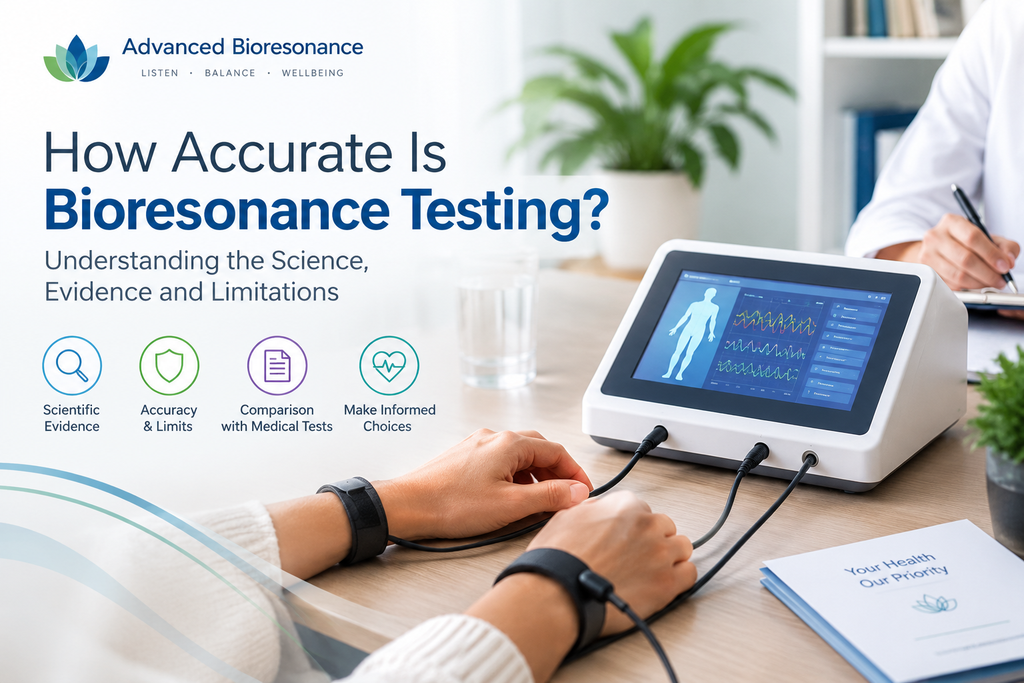
During a session, a practitioner may use a specialised device with sensors or electrodes. Some services also offer hair-based assessments. Practitioners interpret the resulting readings or reports as information about the body’s supposed frequency patterns.
Bioresonance testing is sometimes promoted for assessing food sensitivities, environmental reactions and general wellness. However, these proposed uses are not all supported by reliable scientific evidence.
It is important to remember that a device producing a reading does not automatically mean it can accurately identify a medical condition.
How Accurate Is Bioresonance Testing?
Bioresonance testing has not been established as a reliable diagnostic method for identifying medical conditions, food allergies or intolerances.
The accuracy of a medical test should be demonstrated through well-designed scientific studies. These studies should compare the test’s results with appropriate reference standards and assess whether it consistently identifies the condition being investigated.
For bioresonance testing, robust evidence establishing reliable diagnostic accuracy for the broad range of conditions sometimes claimed by providers is lacking.
The UK’s Advertising Standards Authority (ASA) has published guidance explaining that medical claims made for bioresonance devices require adequate scientific evidence. Its guidance states that it has not seen evidence demonstrating that these devices can diagnose medical conditions or prevent or treat disease.
Therefore, anyone considering bioresonance testing should understand that its results cannot replace an appropriate medical assessment.
What Factors Affect the Accuracy of Bioresonance Testing?
Several factors are important when evaluating any health test.
1. Scientific Evidence
A reliable diagnostic test needs evidence from appropriately designed studies. Claims should not be accepted simply because a device uses advanced technology or produces a detailed report.
2. Repeatability of Results
A test should produce consistent results when repeated under similar conditions. If results vary considerably, interpreting them as dependable health information becomes difficult.
3. False Positive and False Negative Results
A false positive suggests that a person has a condition when they do not. A false negative occurs when a test fails to identify a condition that is present.
Without reliable validation, it is difficult to determine how often bioresonance testing produces these errors.
4. Interpretation of Results
Different practitioners may explain reports differently. A result should not be treated as a confirmed diagnosis without appropriate supporting evidence.
Bioresonance Testing vs Conventional Medical Tests
The following table explains the main differences between bioresonance testing and established diagnostic methods.
| Feature | Bioresonance Testing | Established Medical Testing |
|---|---|---|
| Scientific validation | Reliable diagnostic accuracy is not established for broad claims | Evaluated for specific conditions |
| Food allergy assessment | Not a validated method | Skin-prick tests, specific IgE blood tests and clinical assessment where appropriate |
| Food intolerance assessment | Cannot reliably establish an intolerance | Depends on the suspected condition; specific investigations may be recommended |
| Diagnosis of disease | Not established as a reliable diagnostic tool | Uses validated methods appropriate to the suspected condition |
| Interpretation | Often based on practitioner interpretation of device readings | Guided by clinical evidence and established diagnostic criteria |
| Medical decision-making | Should not replace medical assessment | Can support diagnosis when appropriately selected and interpreted |
The right medical test depends on your symptoms and medical history. Not every condition requires the same investigation, and some tests are useful only when combined with a clinical assessment.
Can Bioresonance Testing Identify Food Allergies?
Food allergies can cause symptoms ranging from mild reactions to potentially life-threatening emergencies. It is therefore important to use appropriate diagnostic methods.
Bioresonance testing has not been scientifically established as a reliable way to diagnose food allergies. Established assessment may include a medical history, skin-prick testing or specific IgE blood tests, depending on the suspected allergy.
Food intolerances are different from allergies and may require different investigations. For example, suspected coeliac disease requires appropriate medical testing.
Avoid removing several foods from your diet solely because of a bioresonance report. Unnecessary restrictions may make it harder to maintain a balanced diet and could delay the correct diagnosis.
Is Bioresonance Testing Safe?
The physical risks associated with a particular session depend on the equipment and procedure used. However, an important concern is the possibility of misleading results.
Relying on an unvalidated test could lead someone to avoid nutritious foods unnecessarily, overlook symptoms or delay appropriate medical care.
If you are experiencing persistent symptoms, consult a qualified healthcare professional. Never delay urgent medical attention because of a bioresonance assessment.
Frequently Asked Questions
Is bioresonance testing 100% accurate?
No. There is insufficient reliable scientific evidence to establish bioresonance testing as an accurate diagnostic method for the conditions commonly claimed by providers.
Can bioresonance testing detect all food intolerances?
No. It has not been validated as a reliable method for identifying food intolerances. Appropriate assessment depends on the suspected condition.
Should I trust my bioresonance report?
Treat the report cautiously. It should not be considered a confirmed medical diagnosis or used as the sole basis for treatment or dietary changes.
What is the best alternative to bioresonance testing?
There is no single alternative for every concern. A GP or appropriately qualified healthcare professional can recommend suitable investigations based on your symptoms and medical history.
Final Thoughts
So, how accurate is bioresonance testing? Current scientific evidence does not establish it as a reliable diagnostic method for identifying diseases, food allergies or intolerances.
If you are considering bioresonance as part of a complementary wellness approach, make sure you understand its limitations. For medical concerns, choose evidence-based investigations and seek advice from a qualified healthcare professional.
Making informed decisions based on reliable evidence can help you protect your health and avoid unnecessary testing or dietary restrictions. for more visit our facebook and instagram page.