Bioresonance testing is an alternative wellness approach that claims to assess the body’s responses using electromagnetic signals. It has attracted interest from people looking for additional ways to understand their health and well-being. However, one important question remains: How accurate is bioresonance testing, and can its results be trusted?
Understanding the scientific evidence, potential limitations, and differences between complementary wellness approaches and conventional medical tests can help people make informed decisions. In this article, we explore how bioresonance testing works, what research says about its accuracy, and what to consider before choosing a session.
What Is Bioresonance Testing?
Bioresonance testing is a complementary approach that uses electronic equipment to measure or interpret signals that practitioners associate with the body’s electromagnetic activity.
Some practitioners claim that these devices can identify imbalances associated with allergies, food sensitivities, or other health concerns. However, these claims vary between practitioners and devices.
There is currently insufficient reliable scientific evidence to establish that bioresonance testing can accurately diagnose medical conditions. It should not be considered a substitute for established medical investigations.
How Does Bioresonance Testing Work?
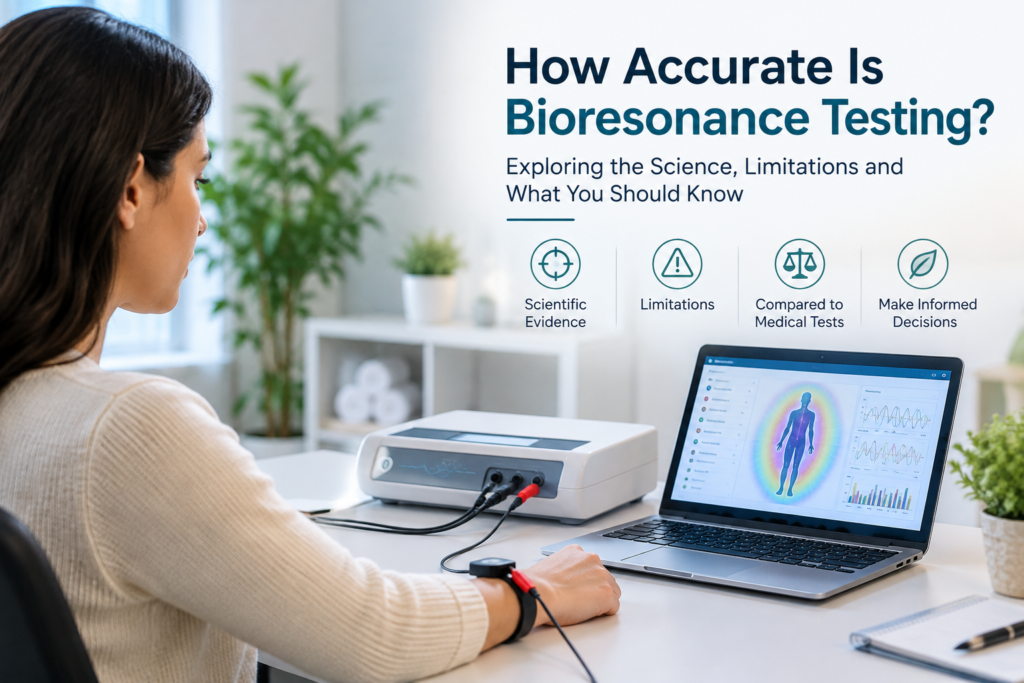
During a typical session, a practitioner may ask questions about your health history and use a device connected to sensors, electrodes, or handheld components.
The equipment processes measurements and produces results that the practitioner interprets according to the device’s method.
What Happens During a Session?
A bioresonance session may involve the following steps:
- Initial consultation: The practitioner discusses your concerns, symptoms, and general health history.
- Device assessment: Sensors or other equipment are used according to the practitioner’s procedure.
- Result interpretation: The device generates readings that the practitioner explains.
- Discussion of next steps: The practitioner may discuss general wellness options or suggest further assessment.
The exact process varies depending on the equipment and practitioner. The fact that a device produces detailed readings does not, by itself, demonstrate that those readings accurately identify a health condition.
How Accurate Is Bioresonance Testing According to Science?
The accuracy of a medical test is usually evaluated through research comparing its results with accepted diagnostic methods. Important measures include sensitivity, specificity, repeatability, and the ability to distinguish people with a condition from those without it.
For bioresonance testing, robust independent evidence establishing reliable diagnostic accuracy across the range of conditions sometimes claimed is lacking.
A device may generate consistent readings without those readings being clinically meaningful. Therefore, claims about identifying allergies, food intolerances, or illnesses should be treated cautiously unless supported by appropriate clinical research.
Factors That Affect Test Accuracy
Several factors are important when evaluating a bioresonance assessment:
- Scientific validation: Has the specific device been independently tested using appropriate clinical methods?
- Repeatability: Does the equipment produce consistent results when the assessment is repeated?
- Practitioner interpretation: Are conclusions based on validated criteria or subjective interpretation?
- Condition being assessed: Evidence for one application cannot automatically be applied to another.
- Comparison with accepted tests: Have results been compared with recognised diagnostic standards?
These factors help explain why a detailed report should not automatically be interpreted as an accurate medical diagnosis.
Bioresonance Testing vs Conventional Medical Testing
The following table highlights the main differences between bioresonance testing and established diagnostic methods.
| Feature | Bioresonance Testing | Conventional Medical Testing |
|---|---|---|
| Scientific evidence | Limited evidence for many diagnostic claims | Varies by test, with established evidence for many methods |
| Diagnostic accuracy | Not reliably established for many claimed uses | Evaluated for specific conditions |
| Testing methods | Electronic equipment and practitioner-specific procedures | Blood tests, skin tests, imaging, and other validated methods |
| Medical diagnosis | Not established as a reliable diagnostic method | Used by qualified professionals when clinically appropriate |
| Role in healthcare | Complementary wellness approach | Diagnosis, monitoring, and treatment decisions |
Conventional tests are not all equally accurate, but validated tests have defined methods and evidence that helps clinicians understand their limitations.
Can Bioresonance Testing Detect Allergies or Food Intolerances?
Some bioresonance providers advertise testing for allergies, food sensitivities, or intolerances. However, these claims should not be confused with clinically validated allergy testing.
For example, recognised allergy investigations may include skin-prick tests, specific IgE blood tests, and medically supervised food challenges when appropriate. Food intolerance investigations depend on the suspected condition and may involve different methods.
Bioresonance testing has not been established as a reliable replacement for these investigations.
If you suspect an allergy or food-related condition, consult a qualified healthcare professional before eliminating major food groups or changing prescribed treatment.
Is Bioresonance Testing Safe?
The physical risks associated with a session may depend on the equipment and procedure used. However, an important concern is the possibility of false reassurance, unnecessary dietary restrictions, or delayed diagnosis if results are treated as medically conclusive.
Before booking a session, consider the following precautions:
- Ask what the specific device has been independently validated to assess.
- Request clear explanations of the method and its limitations.
- Be cautious of promises to diagnose or cure multiple unrelated conditions.
- Do not stop prescribed medication or postpone medical care because of a test result.
- Discuss ongoing or concerning symptoms with a qualified healthcare professional.
Frequently Asked Questions
Is bioresonance testing scientifically proven?
There is insufficient reliable scientific evidence to support many of the diagnostic claims made for bioresonance testing. Its accuracy should not be assumed without appropriate independent clinical validation.
Can bioresonance testing replace blood tests?
No. Bioresonance testing should not replace medically indicated blood tests, allergy investigations, or other established diagnostic procedures.
Is bioresonance testing worth considering?
Some people explore it as a complementary wellness service. However, it is important to understand the limitations of the evidence, consider the cost, and avoid relying on it to diagnose or treat medical conditions.
Conclusion
How accurate is bioresonance testing? Current scientific evidence does not establish it as a reliable diagnostic method for many of the conditions it is claimed to identify.
Although some people choose bioresonance as a complementary wellness approach, its results should be interpreted cautiously and should never replace validated medical investigations.
If you are considering bioresonance testing, ask questions about the equipment, evidence, and limitations before proceeding. Making informed decisions and consulting qualified healthcare professionals when necessary can help you prioritise your health and well-being. For more visit our facebook and instagram page.