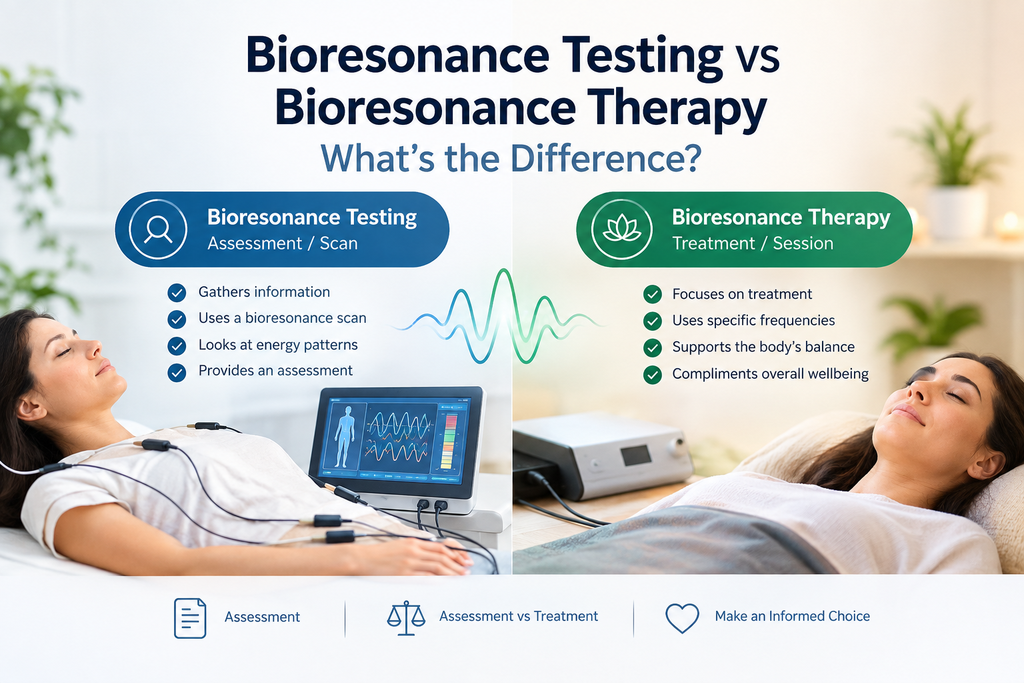
Bioresonance testing and bioresonance therapy are two terms that are often used together, which can make them confusing for people researching complementary wellness approaches. Although they may be offered during the same appointment or as part of the same service, bioresonance testing and bioresonance therapy have different purposes.
In simple terms, testing or assessment is intended to gather information, while therapy refers to the treatment or therapeutic part of a session.
Understanding the difference can help you know what to expect before booking an appointment and, importantly, understand where bioresonance fits alongside conventional healthcare.
What Is Bioresonance Testing?
Bioresonance testing is generally described by practitioners as an assessment process that uses a bioresonance device to collect information about the body’s responses or energy patterns.
A typical bioresonance scan may involve placing sensors or electrodes on or near the body while the practitioner operates the equipment. Depending on the practitioner and device being used, the assessment may be presented as an overview of different areas of wellbeing.
The exact methods and interpretations can vary considerably between practitioners and devices.
It is important to understand that a bioresonance assessment should not automatically be treated as a conventional medical diagnosis. Established medical testing uses validated methods and is interpreted together with symptoms, medical history, examination and other appropriate investigations. For example, NHS allergy services use clinical history alongside appropriate skin, blood or other specialist tests when investigating allergies.
What Happens During a Bioresonance Assessment?
A session may include:
- A discussion about your general wellbeing and concerns.
- The use of sensors or electrodes connected to a bioresonance device.
- An assessment or scan performed according to the practitioner’s protocol.
- A discussion of the information produced by the device.
- Recommendations for the next steps, where appropriate.
The experience can therefore be quite different from a conventional blood test, X-ray or medical diagnostic examination.
What Is Bioresonance Therapy?
Bioresonance therapy refers to the therapeutic part of a bioresonance session.
Practitioners who offer this approach may describe therapy as using a bioresonance device to provide specific frequencies or signals as part of a complementary wellness session.
Unlike an assessment, the purpose of therapy is not primarily to collect information. Instead, the practitioner is carrying out a therapeutic protocol based on the person’s individual circumstances and the approach used by that practitioner.
Because different practitioners may use different equipment and protocols, the exact experience can vary.
It is also important not to confuse complementary therapy with conventional medical treatment. Bioresonance should not be presented as a replacement for appropriate medical diagnosis, emergency care or evidence-based treatment.
Bioresonance Testing vs Bioresonance Therapy: The Main Difference
The easiest way to understand the difference is to think of assessment versus treatment.
| Bioresonance Testing | Bioresonance Therapy |
|---|---|
| Focuses on assessment | Focuses on a therapeutic session |
| Often described as a bioresonance scan | May involve applying signals or frequencies using a device |
| Intended to gather information | Intended to provide a complementary therapy session |
| Usually comes before therapy | May follow an assessment |
| Results may be discussed with the practitioner | The session focuses on the chosen therapeutic protocol |
| Does not replace conventional diagnosis | Does not replace medically indicated treatment |
In short:
Testing = assessment and information
Therapy = therapeutic session
This distinction is useful when comparing different bioresonance services because a practitioner may offer one, the other, or both.
Is a Bioresonance Scan the Same as Bioresonance Therapy?
No. A bioresonance scan and bioresonance therapy are not necessarily the same thing.
A scan or assessment is generally the information-gathering stage. Therapy is the subsequent therapeutic process.
For example, a practitioner may first conduct an assessment and discuss the areas the client wants to focus on. If the client chooses to continue, the practitioner may then provide a separate therapy session.
However, not every practitioner follows exactly the same process. Some may combine assessment and therapy during one appointment.
That is why it is useful to ask what is included before booking.
What Can You Expect From a Bioresonance Assessment?
The appointment usually starts with a conversation about your concerns and what you would like to understand about your wellbeing.
The practitioner may then explain how their particular bioresonance equipment works and carry out the assessment.
Afterwards, the practitioner may discuss the results and explain what they mean within their particular approach.
If the assessment raises concerns about a symptom or possible medical condition, it is important to seek appropriate medical advice rather than relying on a bioresonance result alone.
This is particularly important because conventional medical diagnosis relies on validated tests and clinical assessment. For example, NHS guidance notes that allergy diagnosis can involve detailed history together with appropriate skin or laboratory testing depending on the situation.
What Can You Expect From Bioresonance Therapy?
A bioresonance therapy appointment generally focuses on the therapeutic process rather than assessment.
The practitioner may explain the planned session and use the bioresonance equipment according to their chosen protocol.
Sessions can vary in length and structure depending on the practitioner, equipment and reason for visiting.
If you are considering therapy, ask the practitioner:
- How does the session work?
- How long does it normally take?
- What does the price include?
- Is an assessment included?
- How many sessions are recommended?
- What should I expect during the session?
- Should I continue my existing medical treatment?
A responsible practitioner should be comfortable explaining what their service can and cannot do.
Does Bioresonance Testing Diagnose Medical Conditions?
This is an important distinction.
A bioresonance assessment should not be assumed to provide a medical diagnosis simply because a device produces a result or report.
Medical diagnosis generally requires appropriate clinical evaluation and validated diagnostic methods. The evidence and accepted medical use of bioresonance methods are different from established diagnostic tests.
Some medical guidance has specifically questioned bioresonance and other bioenergetic procedures where there is insufficient scientific or medical basis for diagnosis or treatment.
For that reason, if you have persistent, severe or unexplained symptoms, speak with an appropriately qualified healthcare professional.
Can Testing and Therapy Be Used Together?
Some practitioners offer both services as part of a wider complementary wellness programme.
A typical structure might look like this:
Initial consultation → Assessment → Discussion → Optional therapy → Follow-up
The assessment may help the practitioner understand what the client wants to focus on, while the therapy session is intended to provide the complementary intervention.
However, the exact process depends on the provider.
There is no universal bioresonance protocol followed by every practitioner, so it is worth checking what is actually included in an appointment.
Which One Should You Choose?
There is no single answer because testing and therapy serve different purposes.
If you are primarily interested in understanding how a practitioner approaches your concerns, you may start with an assessment or consultation.
If you already understand the service and are specifically interested in a complementary therapy session, you may be looking for bioresonance therapy.
In many cases, the most sensible first step is to have a conversation with the practitioner and understand exactly what they offer.
Most importantly, do not use a bioresonance assessment to delay appropriate medical care or replace medically recommended tests and treatments.
Frequently Asked Questions
What is the difference between bioresonance testing and therapy?
Bioresonance testing is generally described as an assessment designed to gather information, while bioresonance therapy refers to the therapeutic part of a session. They may be offered together but have different purposes.
Is a bioresonance scan the same as therapy?
No. A bioresonance scan is generally an assessment, whereas therapy refers to the therapeutic session. A practitioner may provide both during the same appointment or as separate sessions.
How long does a bioresonance assessment take?
The length varies between practitioners and equipment. Before booking, ask how long the assessment takes and whether consultation time is included.
Do I need a bioresonance assessment before therapy?
Not necessarily. Different practitioners use different approaches. Some offer an assessment first, while others may discuss your needs before beginning therapy.
Can bioresonance testing replace medical tests?
No. Bioresonance assessment should not be used as a replacement for appropriate medical diagnosis or clinically indicated tests.
Is bioresonance therapy a replacement for conventional treatment?
It should not be considered a replacement for medically indicated treatment. If you have a diagnosed condition or ongoing symptoms, discuss complementary therapies with your healthcare professional.
Final Thoughts
The difference between bioresonance testing and bioresonance therapy is mainly about purpose.
Testing or assessment is focused on gathering and discussing information, while therapy is focused on the complementary therapeutic session.
Understanding this difference can make it easier to choose the right service and ask useful questions before your appointment.
If you are considering bioresonance, look for a practitioner who clearly explains their methods, does not make unrealistic promises and encourages appropriate medical care when needed.
Most importantly, think of bioresonance as a complementary approach rather than a substitute for established medical diagnosis and treatment. for more visit our facebook and instagram page.