
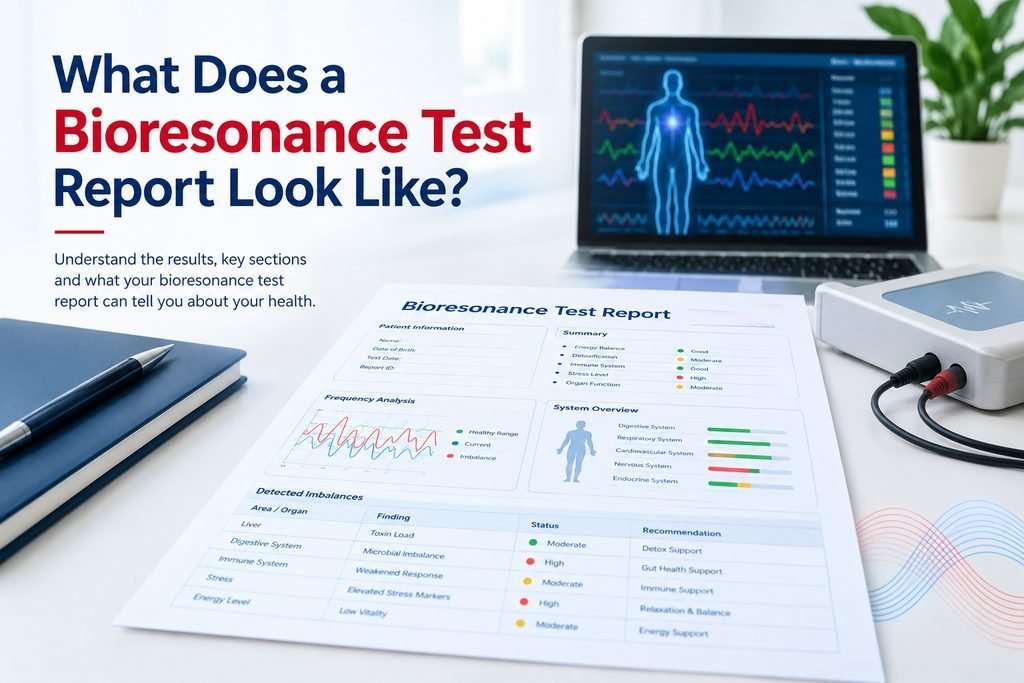
A bioresonance test report is a document provided by some bioresonance practitioners after a testing session. Depending on the device and practitioner, it may include graphs, colour-coded indicators, numerical readings, and summaries of different body systems. Understanding the layout can help you discuss the results with your practitioner and know which questions to ask.
If you are considering bioresonance testing for the first time, you may wonder what information the report contains, how to interpret its sections, and whether the results can tell you something meaningful about your health. This guide explains what a typical bioresonance test report may look like and what to keep in mind when reviewing it.
What Is a Bioresonance Test Report?
A bioresonance test report is a summary of the readings or measurements produced by a bioresonance device during a session. The exact format varies between devices, software systems, and practitioners.
Some reports are simple, with a few readings and brief comments. Others contain several pages featuring charts, colour-coded results, and lists of areas the practitioner may wish to discuss.
It is important to understand that bioresonance testing is not a scientifically established method for diagnosing medical conditions. Its results should not be treated as a substitute for validated medical tests or a professional medical assessment.
What Information Does a Bioresonance Report Include?
Although every report is different, several sections may commonly appear.
1. Patient Information
The first section may contain basic details, such as the patient’s name, test date, report reference, or practitioner information. This section helps identify the session to which the report belongs.
2. Summary of Results
Some reports provide an overview of the readings generated by the device. Results may be grouped into categories, with labels such as normal, moderate, high, or outside a suggested range.
These labels are specific to the device or practitioner. They should not automatically be interpreted as evidence of a disease, deficiency, or medical problem.
3. Graphs and Frequency Readings
Graphs are often used to display patterns or numerical readings. Depending on the software, you may see coloured lines, waveforms, scales, or comparison charts.
Although these graphics can look similar to charts from medical diagnostic equipment, their appearance alone does not establish that the measurements are clinically valid or that they can identify a health condition.
4. Body System Overview
A report may organise readings under headings such as the digestive system, immune system, respiratory system, or cardiovascular system.
These headings indicate the categories used by the device or practitioner. They do not necessarily mean that the corresponding organs or systems have been medically examined or diagnosed.
5. Practitioner Comments and Recommendations
The final section may include observations, suggested lifestyle changes, or recommendations for follow-up. Ask your practitioner to explain the reasoning behind each recommendation and whether it is supported by reliable medical evidence.
Example of a Bioresonance Test Report
The following table illustrates how information might be presented in a hypothetical report. It is an example of report formatting, not a real test result or a validated medical assessment.
| Report section | Example of what you might see | What it means |
|---|---|---|
| Patient details | Test date and reference number | Identifies the session |
| Summary | Colour-coded indicators | Shows device-generated categories |
| Frequency analysis | Graphs and waveforms | Displays readings produced by the software |
| Body system overview | Digestive or respiratory categories | Groups readings by system |
| Practitioner notes | Observations and suggestions | Records comments for discussion |
How to Read a Bioresonance Test Report
If you receive a report, take time to review it with the practitioner rather than interpreting every number or colour independently.
Start by asking what each section measures and how the device generates its readings. Find out whether the displayed ranges have been validated for their intended use and whether reliable clinical evidence supports the conclusions.
Be particularly cautious if a report claims to identify allergies, infections, nutritional deficiencies, organ disease, or other medical conditions without appropriate validated testing. Such claims require independent medical assessment.
If you have symptoms or concerns about your health, consult a qualified healthcare professional. They can recommend suitable examinations and evidence-based tests where necessary.
Is a Bioresonance Test Report Medically Accurate?
The appearance of a report does not determine its accuracy. A professional-looking document with detailed charts and colour-coded results may still lack scientific validation.
Bioresonance has not been established as a reliable diagnostic method for identifying diseases or determining overall health status. Therefore, its findings should not be used alone to make medical decisions, start or stop medication, or avoid recommended screening.
You can use the report as a starting point for questions, but important health concerns should be assessed using established medical methods.
Frequently Asked Questions
What does a typical bioresonance test report look like?
It may contain patient details, graphs, numerical readings, colour-coded indicators, body system categories, and practitioner comments. The format depends on the device and software used.
Do the colours on a bioresonance report indicate a medical problem?
Not necessarily. Colours usually represent categories defined by the particular device or practitioner. They are not proof of a disease or abnormality.
Can a bioresonance report diagnose an illness?
Bioresonance has not been established as a reliable method for diagnosing medical conditions. Diagnosis should be based on an appropriate clinical assessment and validated testing.
Should I share my bioresonance report with my doctor?
Yes, if you have health concerns or questions about the results. Your doctor can help you understand whether further assessment or established medical testing is appropriate.
Final Thoughts
A bioresonance test report may look detailed, with graphs, frequency readings, colour-coded indicators, and summaries of different body systems. However, understanding its layout is different from confirming that its findings are medically accurate.
Review the report carefully, ask your practitioner clear questions, and seek qualified medical advice for symptoms or suspected health conditions. This approach helps you make informed decisions without relying on unverified diagnostic claims. For more visit our facebook and instagram page.